A student-centered curriculum map presents a visual landscape of learning intended to help students see how their learning journeys across courses and other learning opportunities integrate in a cohesive design. A program-level curriculum map represents a cohesive, collaborative vision of how a program helps students to learn, offering both educators and students a visual, collaborative space to contemplate the curriculum. In addition to communicating the interconnected relevance of a degree to students, curriculum maps help faculty to integrate and demonstrate evidence-informed continuous improvement.
Link to UMBC’s undergraduate or graduate curriculum mapping template collections for examples and templates of program, course, and assignment maps. For detailed instructions and examples see A Guide to Curriculum Mapping: Creating a Collaborative, Transformative, and Learner-Centered Curriculum (Harrison & Williams 2024), or request a consultation or workshop.
Mapping as an Evidence-Informed, Continuous Improvement Process
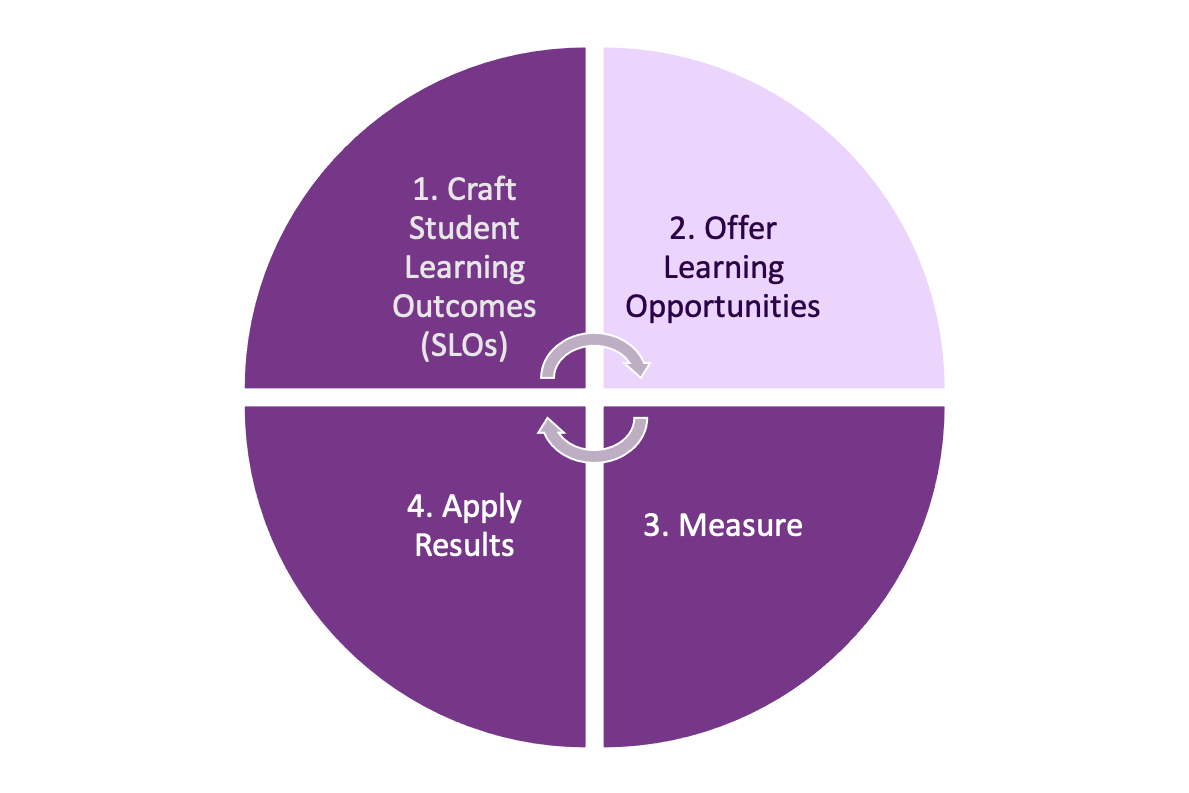 Curriculum mapping helps educators to demonstrate and analyze their curricular design, that is, how they help students to achieve the desired learning results. It is the second part of the learning assessment loop.
To begin the ongoing process of curriculum mapping, educators articulate and align student learning outcomes; sketch how courses and other learning opportunities scaffold this learning; identify assignments with direct measures that challenge students to demonstrate their learning; and analyze and apply the learning results.
Mapping is an ongoing process that relies on faculty collaboration and deliberative dialogue, informed by learning evidence, to continuously improve student learning in programs and courses. Please contact us if you’d like help getting started: many UMBC faculty have participated in FDC-facilitated workshops (in person and online) to initiate, expand, or explore mapping.
In the video below, Peggy Re (Interim Vice Provost for Academic Affairs and Professor in the Department of Visual Arts) details the curriculum mapping session at the Eighth Annual Provost’s Teaching & Learning Symposium, where colleagues explored UMBC’s curriculum, discovered common ground across disciplines, and identified “hidden” learning outcomes. Faculty and staff experts guided visitors through this live mapping experience.
Curriculum Mapping Templates
A curriculum map diagrams relationships between learning outcomes, learning opportunities, and the student learning that emerges. It shows how the parts of a program work together to help learners achieve the outcomes.
To sketch this journey, the mapping process engages the following elements:
- Program-level student learning outcomes appear in the first column to form the rows of the matrix.
- Program outcomes vertically align to institutional outcomes in the second column.
- Student learning opportunities form the columns of the matrix.
- A key defines the intersections between the learning outcomes (rows) and opportunities (columns) to show the level of learning and knowledge (columns).
- Signature assignments measure formative program learning (and summative data for the learning opportunities).
- Capstone and/or final course assessments measure summative program learning.
Notations for horizontal alignment, pedagogies, practices, initiatives, etc. can be added as needed.
Curriculum mapping contextualizes and connects closing-the-loop interventions; creates an ongoing record of the changes and discussions and data; highlights where potential interventions may be needed; creates a repository and system for storing data; and clarifies authentic data aggregation pathways.
Links to Templates
- UMBC Curriculum Map Template (Available upon request by contacting the FDC): Presents a sample curriculum map and template, so you can visualize student learning across your program. The revised and expanded 2022 Excel file also includes a course-level curriculum map template and example, and templates for rubrics and test maps.
- Graduate Curriculum Map Templates (Available upon request by contacting the FDC): Presents a sample graduate curriculum map and template, so you can visualize student learning across your program. The revised and expanded 2022 Excel file also includes a course-level curriculum map template and example, rubric templates for courses and milestones, and aggregators to help you gather the results across the program.
If you have any questions or would like to get started mapping your course or program, please contact the FDC.
Text and graphics created by Jennifer M. Harrison, Ph.D.