FDC Learning Assessment Resources

To help you more easily find the resources you need for student learning assessment, we have reorganized our pages and added new resources. To get started, we suggest you read An Assessment Walkthrough, a short document that previews the learning assessment cycle and offers suggestions for beginning or continuing your assessment work.

The Learning Assessment Loop
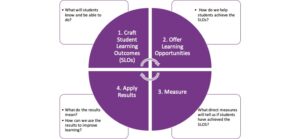
A four-step cycle diagram showing the assessment process, which consists of: first crafting student learning outcomes, second offering learning opportunities, third measuring learning, and fourth applying the results.


After we clarify the desired results of a course or program, stipulate what that learning looks like, and design the learning opportunity, we need a systematic way to find out if our backward course design worked. Did students demonstrate the “desired results?” We use the learning assessment loop to analyze how effectively our course and curriculum designs have helped students to learn.

The learning assessment loop’s four steps help us to apply research-based best practices to improving student learning. The linked pages will help you to …

  1. Craft, clarify, and align student learning outcomes;
  2. Analyze learning opportunities through curriculum mapping;
  3. Measure student learning with direct measures; and
  4. Close the loop, or analyze and apply the learning results.

Additional Assessment Resources

  • Assessment Cycle: the assessment cycle has four parts: setting student learning outcomes (measurable goals), offering learning opportunities (courses and activities), measuring (direct and indirect), and closing the loop, or applying results to continuous improvement.
  • Continuity Mechanisms embed assessment work in everyday processes.
  • Curriculum Mapping uses vertical and horizontal alignment to align outcomes, maps outcomes to learning opportunities, and illustrates how programs scaffold and assess student learning.
  • Direct Measures, like rubrics, tests, and minute papers, look directly at demonstrations of student learning and often rely on subject-matter expertise.
  • Horizontal Alignment highlights relationships across programs and standards to create common ground.
  • Indirect Measures, like student surveys and grades, retention and graduation rates, and usage data, look at factors related to learning.
  • Learning Analytics collects and analyzes data associated with student learning to improve student success.
  • Narrative Aggregation gathers assessment data into cohesive stories of student learning.
  • Signature Assignments challenge students to synthesize multiple learning outcomes in projects that imitate real-world experiences; vertically, they map from the assignment to the course-, program-, and institutional-level learning outcomes. Horizontally, they connect to learning experiences and standards across the nation.
  • Triangulation integrates multiple measures of student learning for context and deeper insights into how interventions work.
  • Vertical Alignment delineates connections from the institutional mission to outcomes at each level to specific assignments.


Did you find what you were looking for today?